Orivoxx
Benchmark the agent, not just the model.




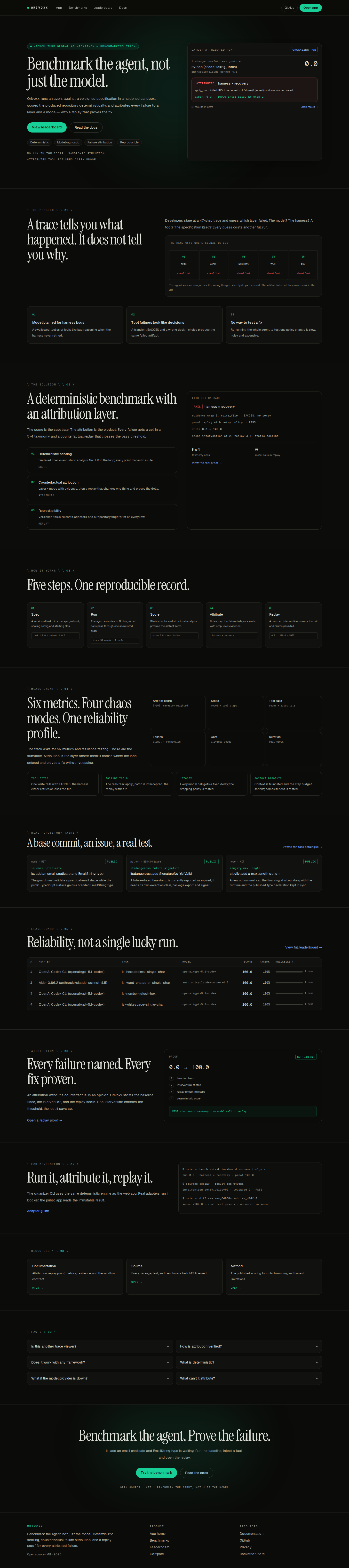
Orivoxx is a benchmarking and failure-attribution platform for AI software-engineering agents. It runs a complete agent configuration — model, harness, tools, orchestration, and stopping conditions — against real GitHub issues inside a hardened Docker sandbox. A deterministic engine scores the produced repository. When the run fails, Orivoxx names the failure by layer × mode and proves the diagnosis with a counterfactual replay that re-runs the real test command.
No model is in the score path. No attribution is accepted without evidence.
Live: https://orivoxx.vercel.app
What is Orivoxx
Agent leaderboards usually compare foundation models behind one fixed harness. That hides the variable practitioners actually choose. Orivoxx treats the whole configuration as the subject: the same model can be run through Claude Code, Codex CLI, or Aider, and the result records the adapter, model, task version, ruleset, scoring config, and repository fingerprint.
A run produces:
- Primary success for real tasks: the repository’s test command exits
0. - Six metrics: steps, tool calls, tool-error rate, tokens, cost, and duration.
- Deterministic quality flags: security patterns and structural maintainability, always published next to the test result.
- A bounded trace of model calls and tool calls, with arguments and results redacted.
- An attribution — one of 20 layer × mode cells, a rule id, step evidence, and (when a tool fault is intercepted) a replay proof.
- A produced-code diff as text, never the full repository or archive.
The scoring engine imports no provider, adapter, or network module; a test proves that invariant on the import graph.
Brand Agents
| Agent | Runtime | OpenRouter route | Status |
|---|---|---|---|
| Claude Code 2.1.329 | sandbox | ANTHROPIC_BASE_URL through the model proxy; sentinel auth token |
Runs; solved slugify-max-length |
| OpenAI Codex CLI 0.171.0 | sandbox | generated config.toml, Responses wire API through the proxy |
Runs; passed the legacy tasks; failed the multi-file is-email-predicate |
| Aider 0.86.2 | sandbox | OpenAI-compatible proxy, pinned in the image | Runs as the baseline |
| GitHub Copilot CLI 1.0.114 | excluded | no OpenRouter base-url override; org policy denied access | Excluded |
| Cursor | excluded | not headless-routeable through OpenRouter | Excluded |
| python-openrouter | sandbox | custom Python loop through the proxy | Chaos and real-task proof harness |
The real provider key never enters the sandbox. Each CLI receives orivoxx-sandbox-proxy; the host-side sidecar injects the OpenRouter key and forwards only model calls plus an allowlisted package-manager CONNECT tunnel. GitHub Copilot and Cursor are deliberately not in the comparison.
Real Tasks
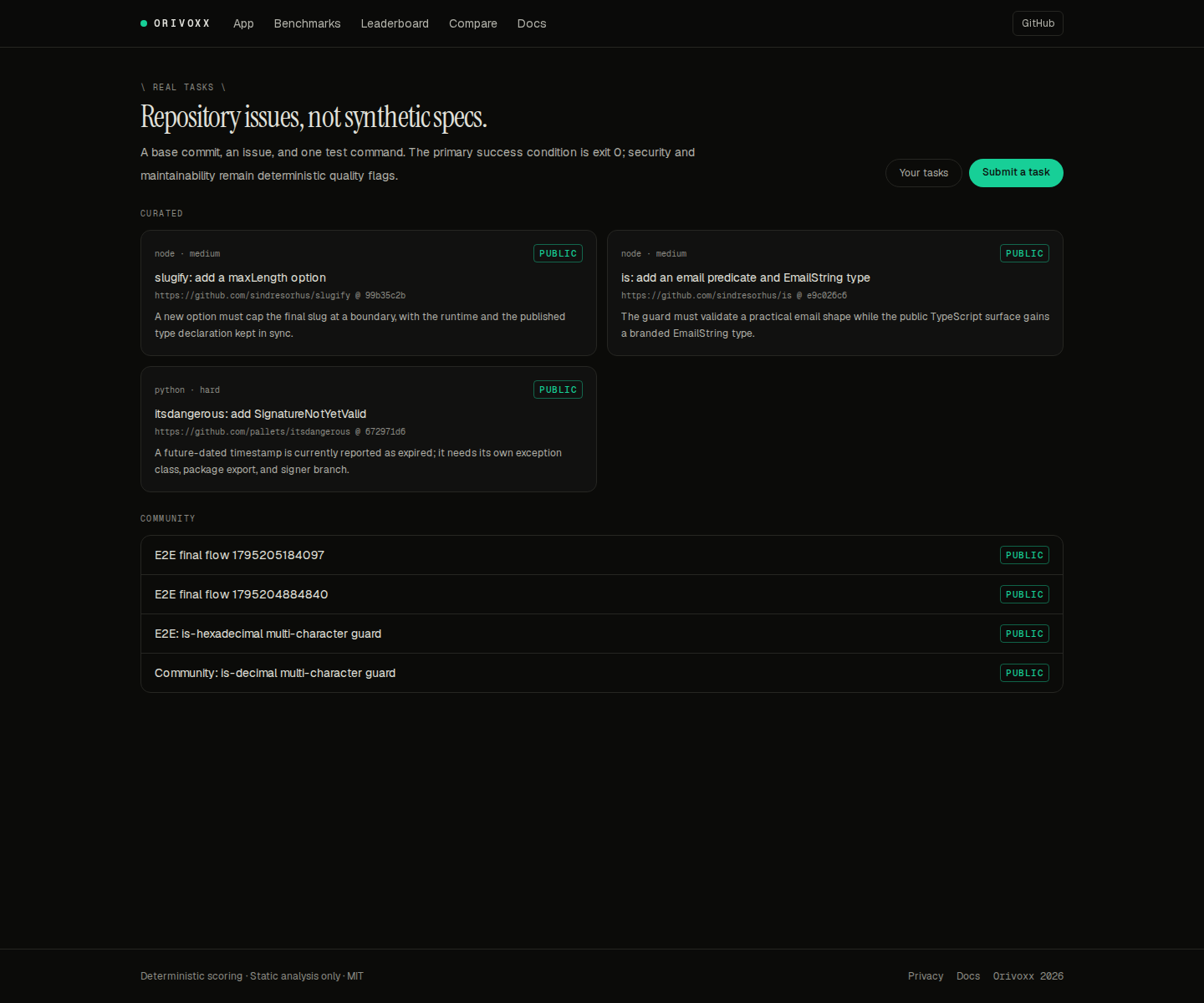
The public comparison set uses real repositories, pinned base commits, a real issue, and one test command. The agent never sees the test command. A task declares its dependency install command; packages are fetched inside the sandbox through the allowlisted registry tunnel (registry.npmjs.org, registry.yarnpkg.com, pypi.org, files.pythonhosted.org). General egress stays closed.
| Task | Repository | License | What must change | Test |
|---|---|---|---|---|
slugify-max-length |
sindresorhus/slugify |
MIT | index.js + index.d.ts |
node --test .orivoxx/acceptance.test.mjs |
is-email-predicate |
sindresorhus/is |
MIT | source/index.ts + source/types.ts |
node --experimental-transform-types --test .orivoxx/acceptance.test.mjs |
itsdangerous-future-signature |
pallets/itsdangerous |
BSD-3-Clause | exc.py + timed.py + __init__.py |
python3 .orivoxx/run_pytest.py |
All three passed the six validation gates: clone, install, test fails at base, deterministic ×3, time bounded, permissive license. Acceptance fixtures live under .orivoxx/ and are rewritten after the agent exits, so an agent cannot weaken the test.
Recorded runs:
| Agent | Task | Test | Duration | Cost | Result |
|---|---|---|---|---|---|
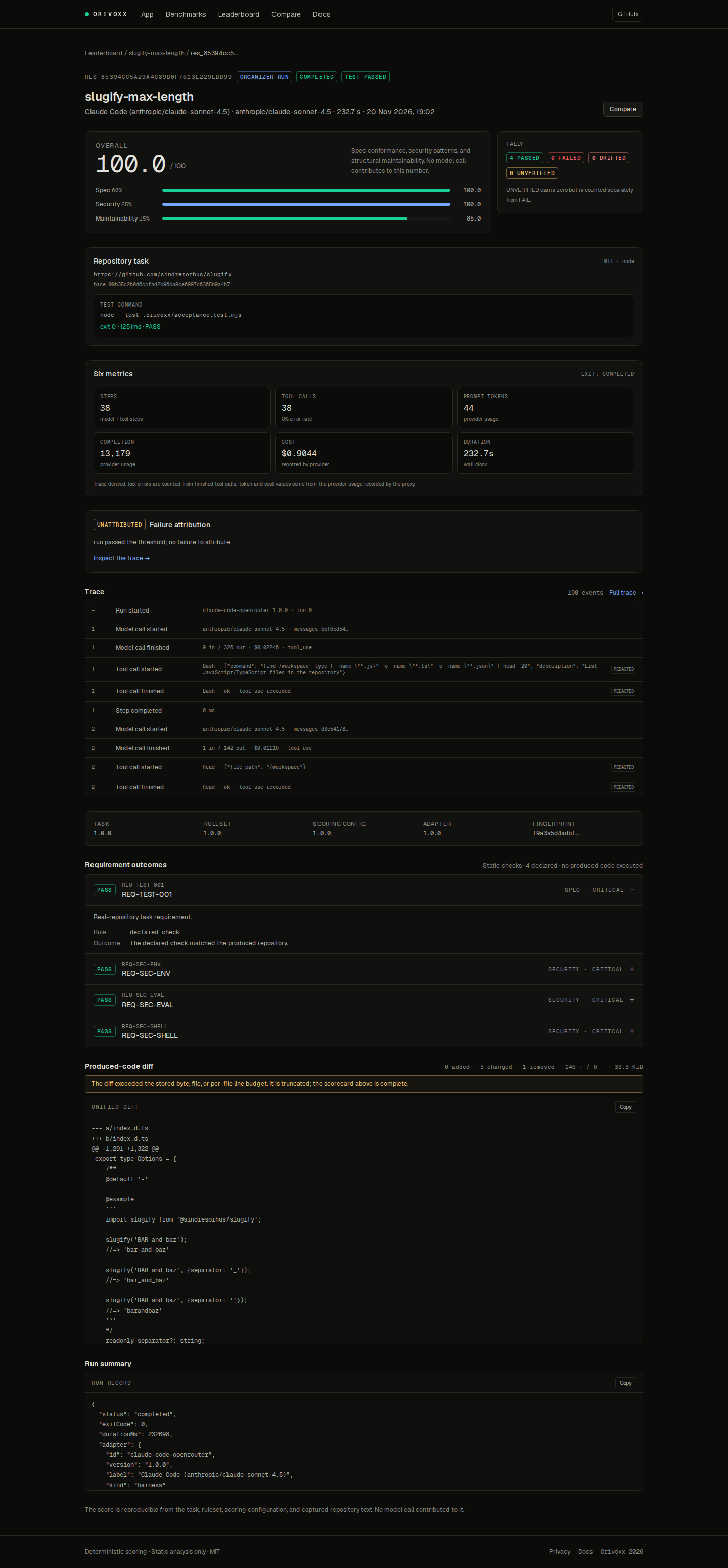
Claude Code (anthropic/claude-sonnet-4.5) |
slugify-max-length |
PASS | 232.7s | $0.9044 | res_85394cc5… |
Claude Code (anthropic/claude-haiku-5.5) |
community is-decimal-800937e9 |
PASS | 11.8s | $0.0015 | res_74101d58… |
Python loop (openai/gpt-5.1) |
community is-decimal-800937e9 |
PASS | 5.6s | $0.0068 | res_2ea69a6f… |
| Codex CLI | is-email-predicate |
FAIL | 492.7s | $0.7198 | res_e2767b1f… |
python (chaos: failing_tools) |
itsdangerous-future-signature |
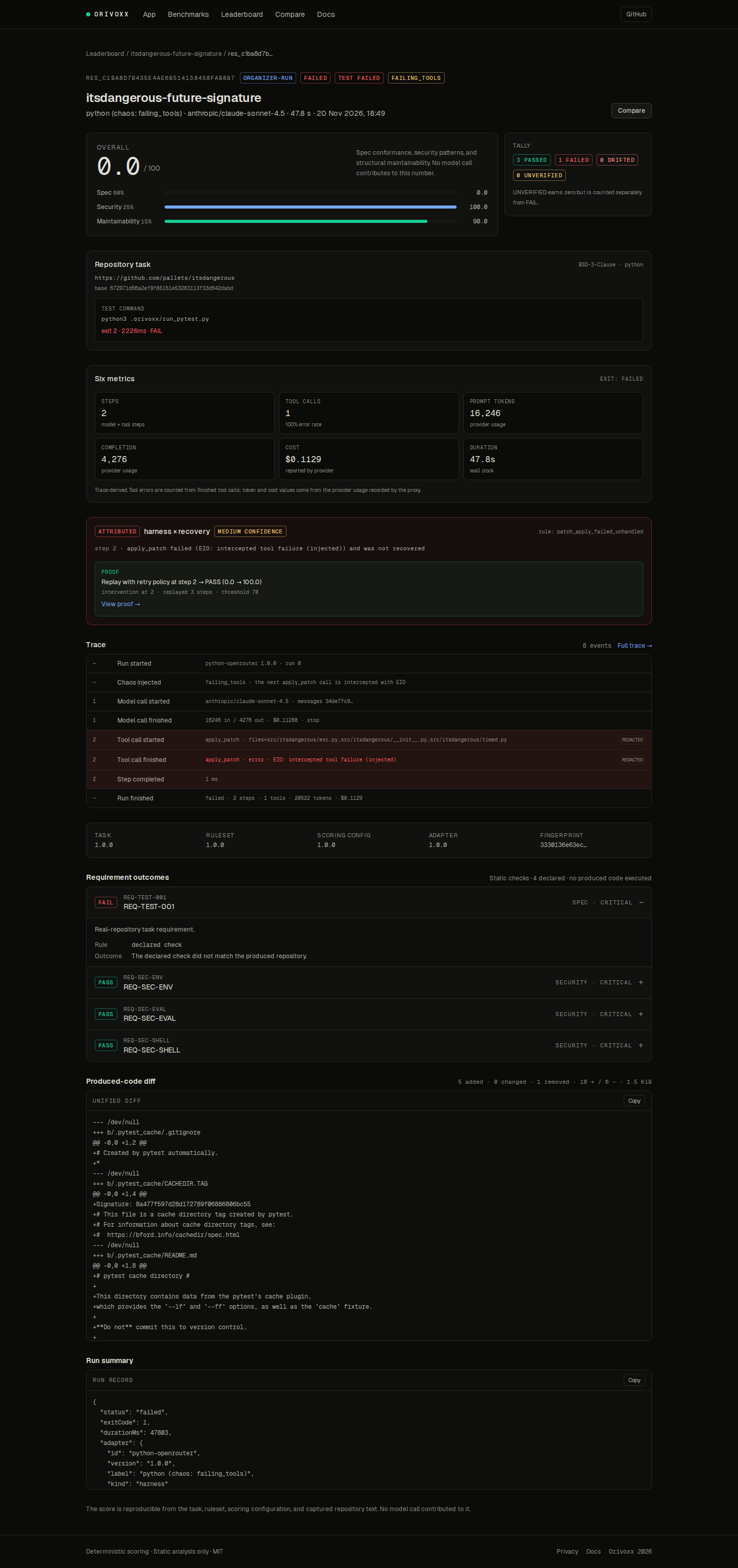
FAIL | 47.8s | $0.1129 | res_c1ba8d7b… |
The Codex failure is a real model decision failure: it added email: isEmail but did not define the predicate, so the acceptance test failed. It is attributed to model × decision without a counterfactual. The chaos run is the proven attribution.
Failure Attribution & Replay
A trace says what happened. Orivoxx answers why. Every attribution is a cell in a 5 × 4 taxonomy:
| Layer | Question |
|---|---|
| Spec | Was the requirement missing, contradictory, or ambiguous? |
| Model | Did the model reason incorrectly, ignore an instruction, or hallucinate? |
| Harness | Did orchestration swallow an error, skip a retry, or stop badly? |
| Tool | Did a tool return a wrong result or fail from its own fault? |
| Environment | Did an external service fail (network, timeout, quota)? |
| Mode | Question |
|---|---|
| Decision | Wrong choice among viable options |
| Execution | Correct choice, failed to execute |
| Recovery | Should have recovered from a fault, did not |
| Detection | Should have noticed an inconsistency, did not |
Seventeen deterministic rules ship today, including test_failed_after_patch (model × decision), patch_apply_failed_unhandled (harness × recovery), test_run_skipped (harness × execution), test_timeout (environment × execution), and issue_ambiguous_vs_test (spec × detection). A rule returns a cell, a step, and evidence; it never inspects source text and never calls a model.
Proven example — harness × recovery
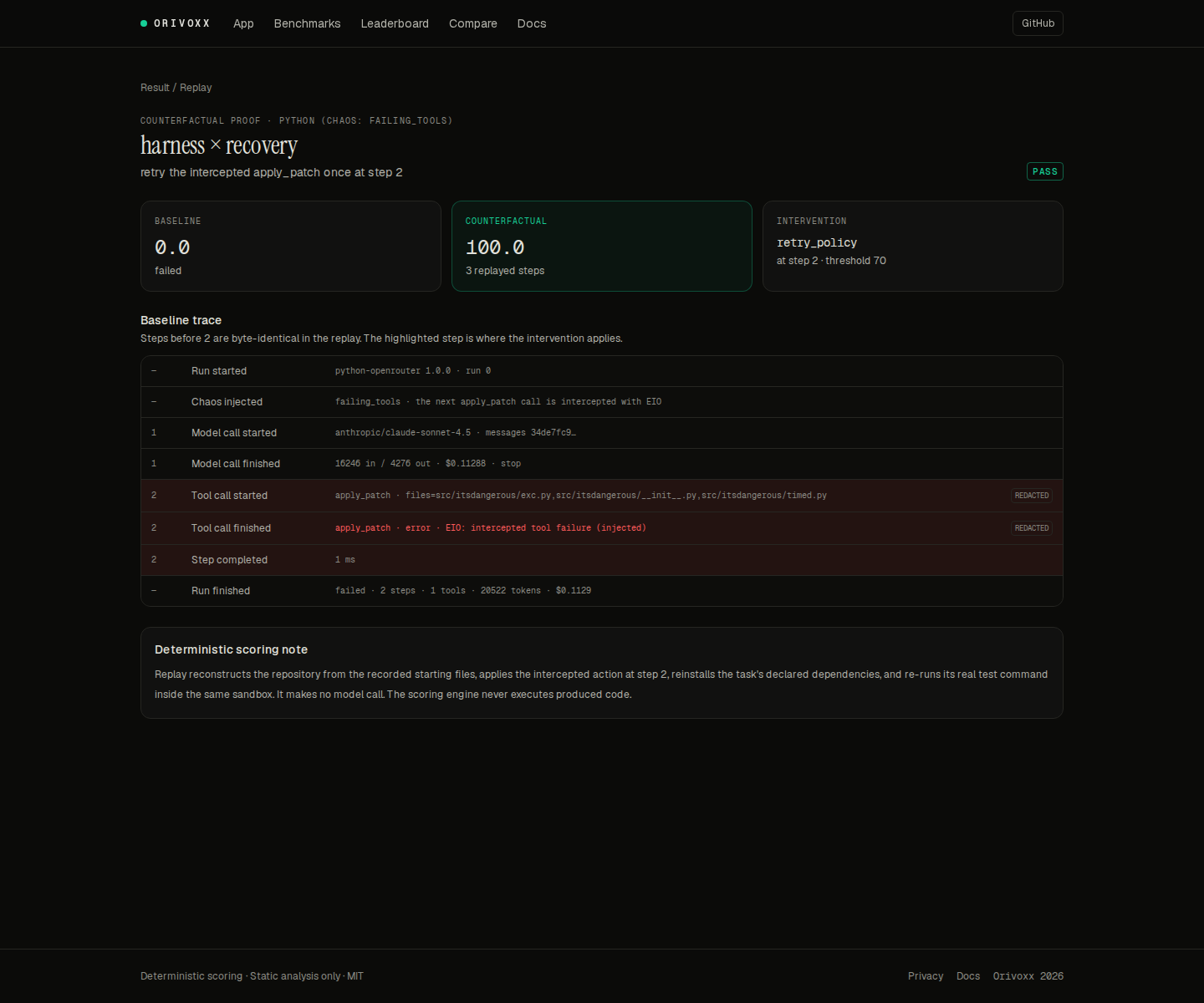
The failing_tools chaos mode intercepts the custom Python harness’s single multi-file apply_patch call at step 2. The agent does not recover; the real test stays red.
Baseline:      0.0  (test failed)
Attribution:   harness × recovery
Rule:          patch_apply_failed_unhandled
Evidence:      step 2 · apply_patch → EIO (injected), no retry
Intervention:  retry_policy at step 2
Replay:        3 actions re-applied; real test command exits 0
Counterfactual: 100.0 PASS
- Result: https://orivoxx.vercel.app/results/res_c1ba8d7b435e4ae6b514138458fab8b7
- Replay: https://orivoxx.vercel.app/replay/res_c1ba8d7b435e4ae6b514138458fab8b7
Replay for a real task reconstructs the workspace from the recorded starting files, applies the intercepted action, reinstalls declared dependencies, and re-runs the real test command in the same sandbox. It makes no model call. The scoring engine never executes produced code.
Community Tasks
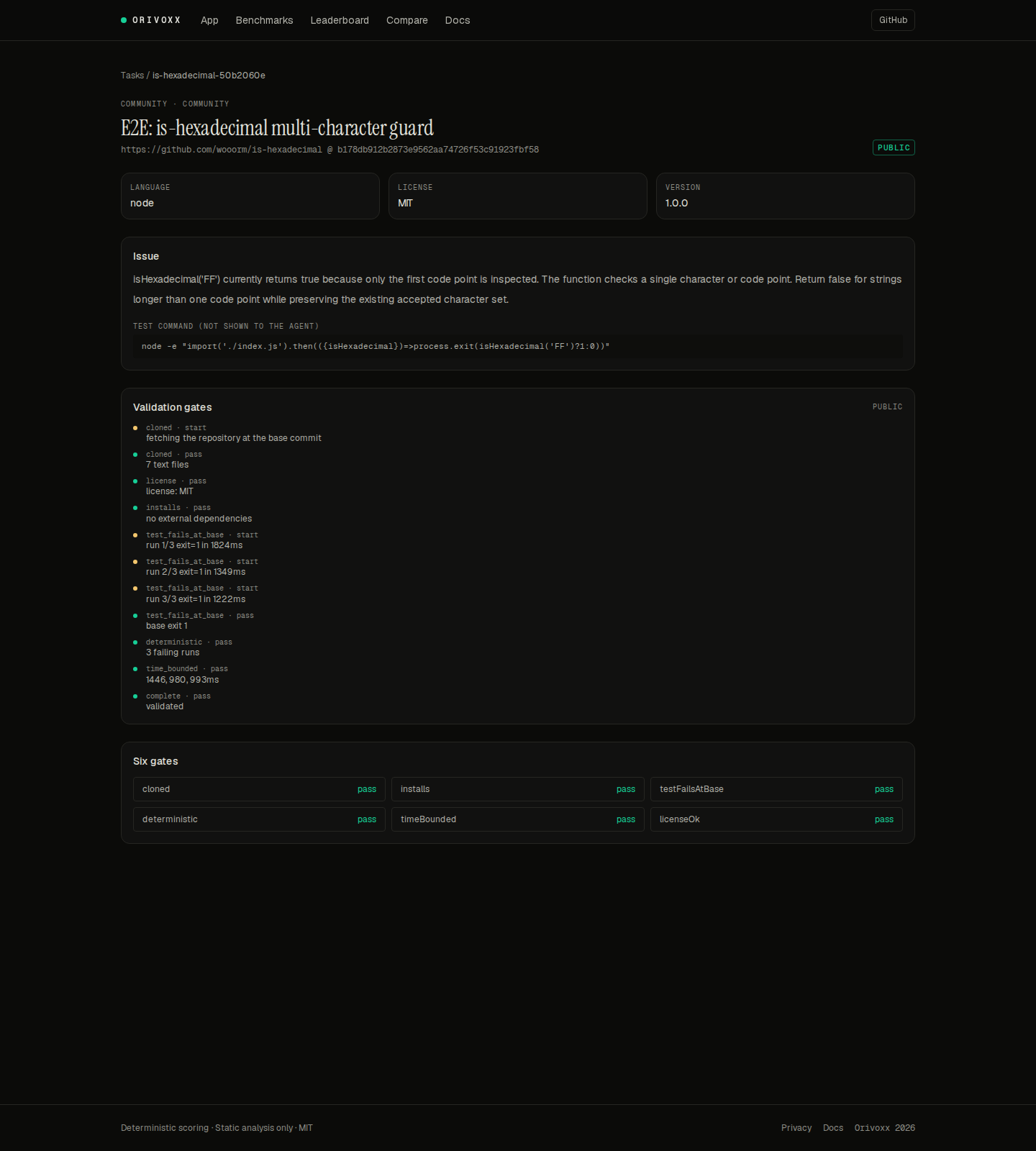
Anyone can submit a real GitHub task at /tasks/new: repoUrl, baseCommit, issueText, one allowlisted testCommand, and public or private visibility. GitHub OAuth is used when GITHUB_CLIENT_ID/GITHUB_CLIENT_SECRET are configured; otherwise an HttpOnly anonymous token hashes to a stable submitter id.
Six mechanical gates run in the same Docker sandbox:
| Gate | Check |
|---|---|
| Cloned | exact base commit fetched; 60s budget |
| Installs | declared install command succeeds through the registry tunnel; 300s |
| Test fails at base | nonzero exit before the agent runs |
| Deterministic | three failing runs at base |
| Time bounded | every run completes under 600s |
| License | GitHub SPDX id, or LICENSE-file heuristic, against a permissive allowlist |
A validated community task is promoted only by a curator in CURATOR_USERNAMES. Private tasks return 403 to every other viewer. Limits: 3 pending per user, 10 per 24h per user, 20 globally per 24h. The operator kill switch ORIVOXX_RUNS_DISABLED=1 stops all mutating submissions before rate limiting or model work.
Live examples:
- Community task validated and promoted: https://orivoxx.vercel.app/tasks/is-decimal-d36f6021
- Private task, owner 200 / second user 403: https://orivoxx.vercel.app/tasks/is-decimal-263f95c1
- Fresh E2E community task: https://orivoxx.vercel.app/tasks/is-decimal-800937e9
Quickstart
git clone https://github.com/productivityapplications/Orivoxx.git
cd Orivoxx
corepack enable
pnpm install --frozen-lockfile
pnpm -r build                # workspace packages first; the web app imports their dist
cp .env.example .env.local   # add OPENROUTER_API_KEY for real agent runs
Web app:
pnpm --filter web build
pnpm --filter web start     # http://localhost:3000
Verify the repository:
pnpm -r typecheck
pnpm -r lint
pnpm -r test                # 495 unit tests; Docker integration is opt-in
pnpm test:e2e               # 5 Playwright flows against a throwaway local store
Run a real task:
pnpm bench:real --task slugify-max-length --adapter claude-code-openrouter
pnpm bench:real --task itsdangerous-future-signature --adapter python-openrouter \
  --model anthropic/claude-sonnet-4.5 --chaos failing_tools
The sandbox image is pinned and reproducible:
pnpm --filter @orivoxx/harness sandbox:build # orivoxx/sandbox:1.0.0
Optional Docker integration tests:
ORIVOXX_DOCKER_TESTS=1 pnpm --filter @orivoxx/harness test
Architecture
Browser
  │  dark-first Next.js App Router UI
  ▼
Vercel (apps/web)
  ├── read APIs + leaderboard + result/replay pages
  ├── community task submission + validation queue
  └── rate limits, origin checks, secure headers, operator kill switch
        │
        ▼
Upstash Redis
  ├── immutable result scorecards + traces + proofs
  ├── leaderboard indexes + reliability aggregation
  └── community tasks, validation events, pending queue, rate counters
        │
        ▼
Organizer runner (VPS, Docker required)
  ├── packages/harness: clone, sandbox, adapters, capture, test
  ├── packages/benchmarks: task registry, real-task validation, deterministic score
  ├── packages/attribution: 17 deterministic rules over trace + scorecard
  ├── packages/replay: counterfactual proof
  └── packages/core: contracts, redaction, static checks
        │
        ▼
Docker sandbox (orivoxx/sandbox:1.0.0)
  ├── non-root, read-only rootfs, tmpfs /tmp, no capabilities, resource limits
  ├── model-proxy sidecar: model egress + allowlisted package CONNECT only
  ├── Claude Code / Codex CLI / Aider pinned in the image
  └── real test command runs inside the sandbox, never on the host
Safety boundaries:
- Only
packages/harnessexecutes agent or test processes, and only through the Docker runner. - The scoring engine is static: it never runs produced code, tests, builds, package installs, or shell commands.
- No platform secrets in the sandbox; the model proxy injects the provider key host-side.
- Archives are processed in memory and bounded; traversal, symlinks, duplicate paths, and oversized input are rejected.
- Result exports contain bounded scorecard JSON and a produced-code diff as text, not full source, archives, prompts, or raw model output.
- Attribution is bounded by evidence; a deterministic
FAILoverrides any model claim, and missing evidence isUNVERIFIED.
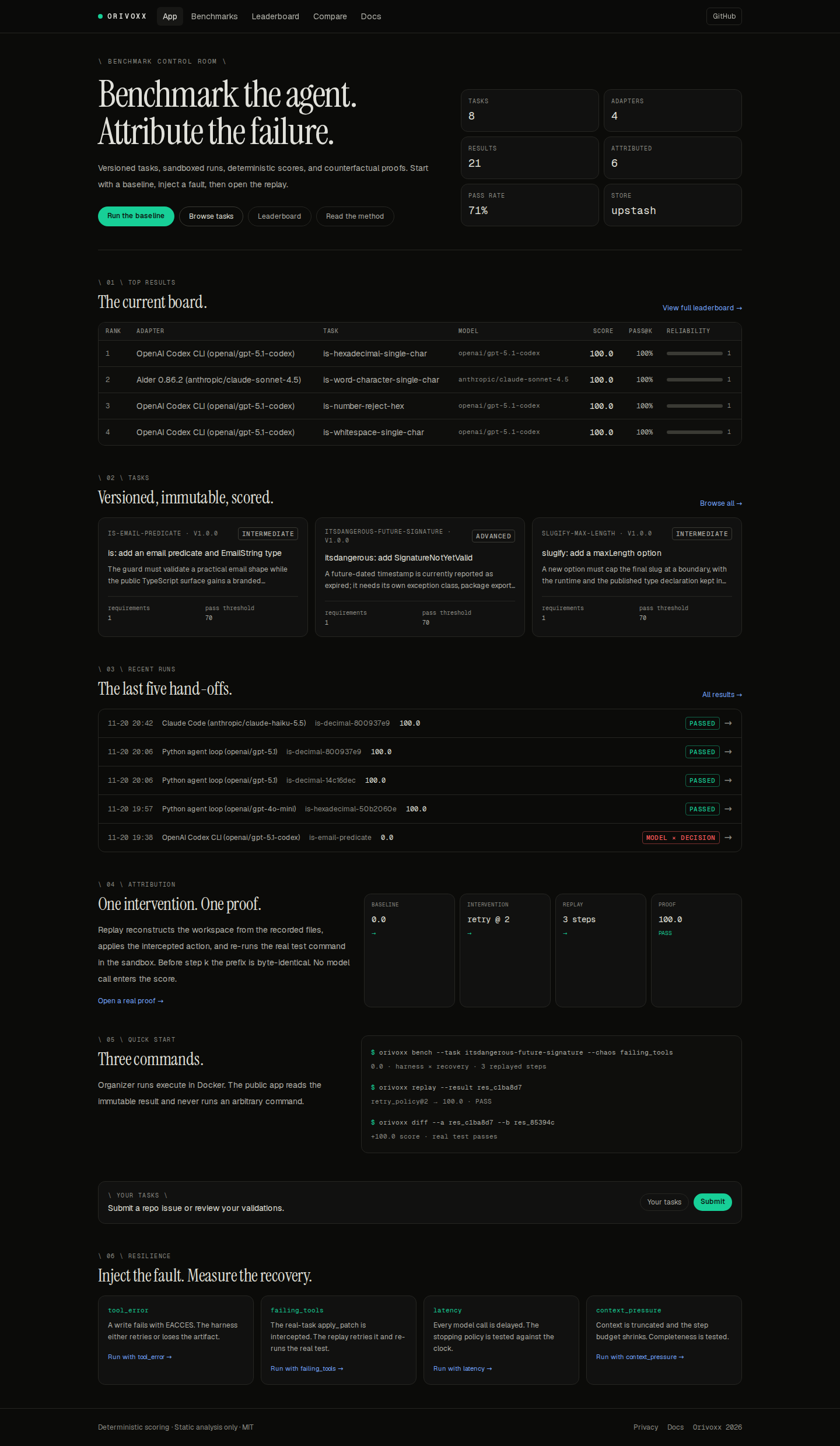
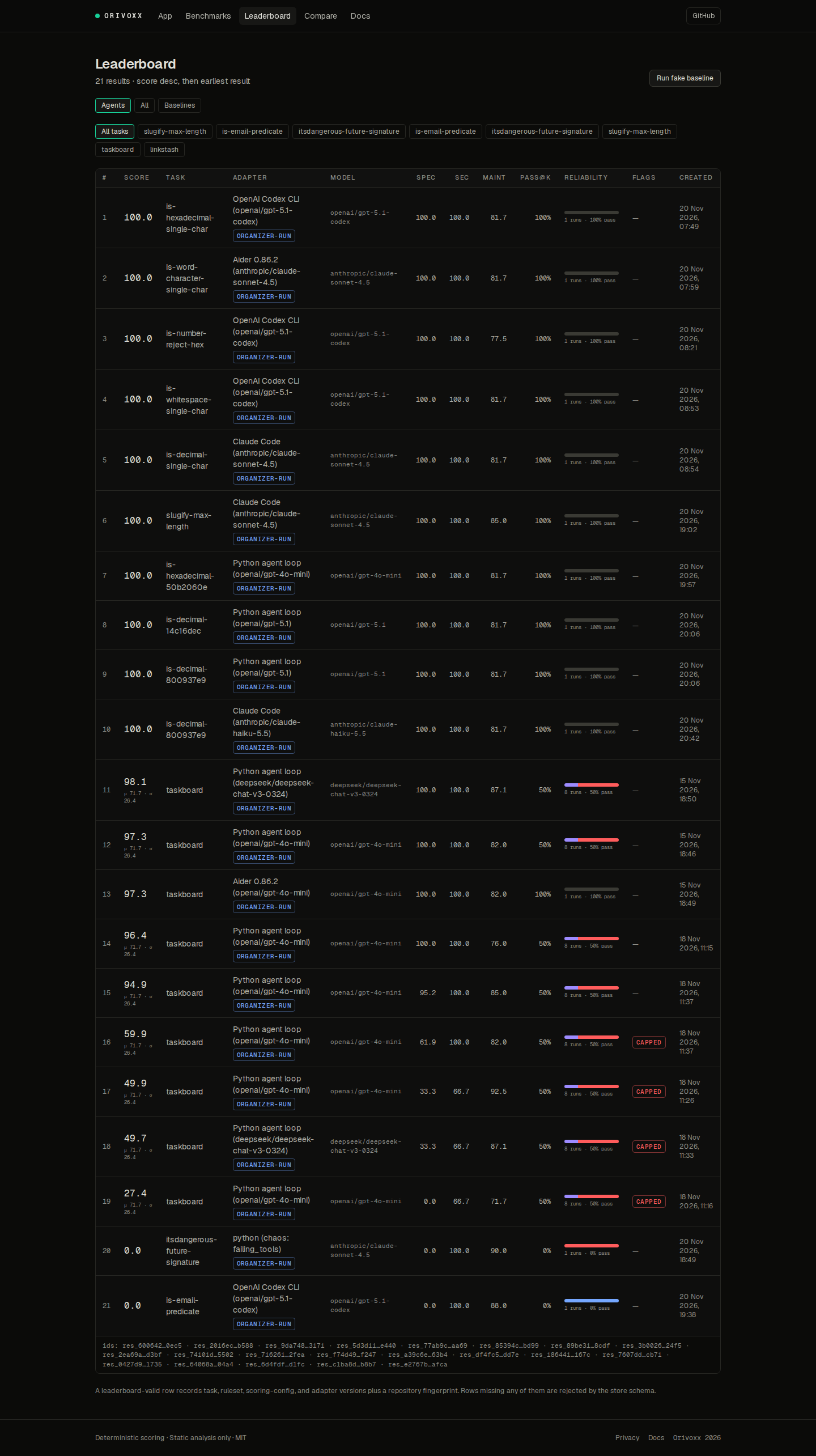
Screenshots
All captures are Playwright screenshots of the production build. Full set in docs/screenshots/.
| Landing | App |
|---|---|
|
 |
| Real tasks | Leaderboard |
|---|---|
 |
 |
| Result | Attribution |
|---|---|
 |
|
| Replay proof | Community task |
|---|---|
|
|
Honest limitations
- Provider budget is real. The final brand-agent runs hit the OpenRouter account credit ceiling. Completed runs are reported; runs that received
402are excluded rather than mislabelled as model failures. Re-run with a funded key to extend the table. - Codex failed one multi-file task. That is a benchmark finding, not hidden: the result is stored with
model × decisionattribution and no counterfactual. - Copilot and Cursor are excluded. Copilot’s org policy denied access and it has no OpenRouter base-url override; Cursor is not reliably headless-routeable.
- GitHub OAuth login was not completed end-to-end because no GitHub account credentials were available in the build environment. The redirect, state cookie, signed session, anonymous fallback, curator promotion, and private-task 403 were exercised.
- Community installs are dependency-bounded. Registry access is allowlisted; general egress is not opened. A task requiring an unlisted registry is rejected, not run outside the sandbox.
- Sample data is labelled. When the result store is unavailable, the leaderboard shows bundled seed rows with a visible
Sample databadge.
Docs
docs/VISION.md— problem, positioning, exclusionsdocs/ARCHITECTURE.md— shipped components and boundariesdocs/BENCHMARKS.md— task and scoring modeldocs/ATTRIBUTION_SPEC.md— 5 × 4 taxonomy and rulesdocs/ADAPTERS.md— adapter contract and brand routingdocs/SANDBOX.md— sandbox and proxy budgetsdocs/FRONTEND_BENCHMARK_SPEC.md— UI contractBUILD_LOG.md— decisions and verification history
License
MIT. Real task repositories retain their own licenses; every curated task records its license and pins its base commit.